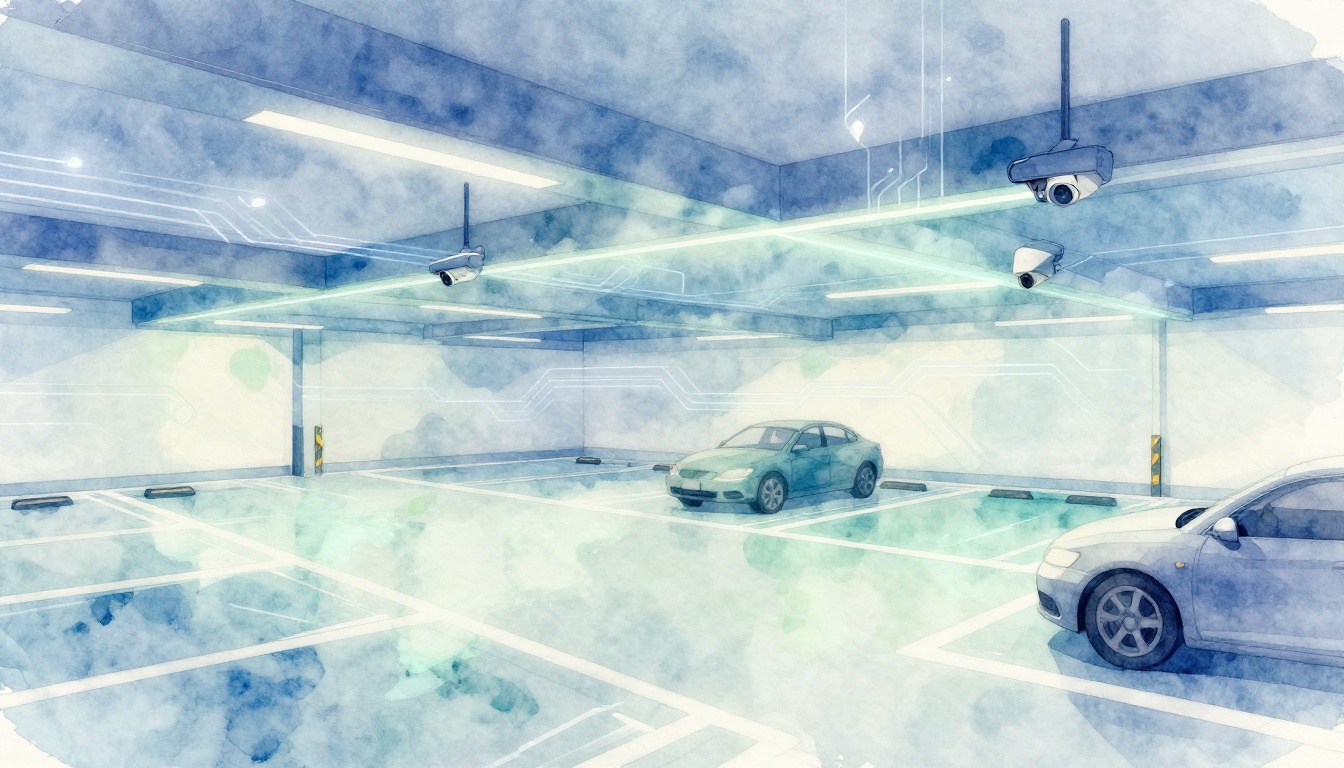
Have you ever circled a busy lot for 10 minutes, burning gas and watching your battery drop on your phone? Then you finally find a spot, and it’s already taken. That frustrating loop is exactly where AI in parking systems is starting to change the experience.
As of March 2026, AI is becoming standard in more garages and curb zones. You’ll see it in smart cameras, plate readers, and prediction apps that reduce guesswork. Instead of treating parking like a mystery hunt, AI helps systems spot open spaces, guide you to them, and handle payment and enforcement with fewer frictions.
In the sections below, you’ll see how AI does those jobs, where it helps most, and what challenges still need real-world fixes.
How AI Detects and Guides You to Open Spots
AI starts with one simple goal: know what’s happening in the parking area, right now. To do that, many systems use AI video analytics and computer vision cameras mounted above lanes or rows. The cameras don’t just “watch.” They interpret scenes, track vehicles, and figure out which spaces are free.
Then the system turns those facts into guidance. That might mean a mobile app that shows nearby availability, or sensors at the entrance that route you to the right section. In other words, AI helps the parking lot act like a host, not a maze.
Inside the machine, AI often combines several inputs:
- Camera feeds from multiple angles
- Data from IoT sensors (like occupancy counts in an area)
- Context data (time of day, events, and even weather)
One camera can also replace a bunch of older sensors. When the view is clear, computer vision can estimate whether each marked space is occupied. That matters because most lots have tight budgets, and maintenance is expensive. AI can reduce hardware sprawl, while still covering more ground.
Once it can see availability, AI can also predict near-future availability. If it knows a concert just ended, it can expect a wave of cars leaving. Then it can forecast where spots will open up first.
Some operators package these ideas into end-to-end solutions. For example, Intel describes an approach to smart parking that combines edge processing with real-time control concepts in its Smart Parking Redefined solution.

So what does that look like for you? Imagine arriving at a mall on a Saturday. Instead of following vague signs, your app can point you to the closest likely-free row, then adjust as cars move. The difference is that AI updates guidance as reality changes.
Spotting Spots with Smart Cameras and Sensors
“Is it empty?” is the first question AI answers, and it does it with computer vision. Cameras analyze each space, then estimate occupancy. Over time, machine learning improves the model so it handles common problems like shadows, lighting changes, and angled views.
AI can also classify what it sees:
- Vehicle type (car vs. SUV, sometimes by height)
- Length of stay (how long a space stays occupied)
- Traffic patterns (which lanes are busy, which are underused)
That matters because EV charging adds a new layer. Many lots reserve spots for chargers. AI can help identify when an EV charger space is free, and when it’s likely to stay taken because of typical charging time.
Some systems go further with ANPR (automatic number plate recognition). Instead of relying only on “a blob of a car,” the system can read the plate. That enables faster check-in and exit, and it supports enforcement without long manual reviews.
With ANPR, the parking system can match a car to rules. For example, it can allow entry for a pre-registered vehicle, track usage for billing, or flag long stays based on real rules. If a garage uses plate-based access, you’ll often see fewer paper tickets and fewer “where do I pay?” moments.
Even in everyday terms, think of it like a smart vending machine. The machine doesn’t guess. It checks what product you picked, confirms payment, then completes the transaction. Parking gets similar behavior when AI ties a plate to an access event.
Predicting Where Spots Will Be Free Next
Seeing “today’s availability” is helpful. Predicting “the next best spot” is where AI really cuts stress.
AI parking systems often forecast occupancy using real-time inputs. They can pull live movement data from cameras and sensors, then combine it with patterns learned from history. Time of day and day of week matter, but events matter more.
A stadium is a good example. During an event, spaces fill in waves. After the crowd leaves, the exit rush creates a second wave of openings. AI can detect that shift early, then forecast which sections will clear first.
This beats old-school manual counts. Manual counts are snapshots. They stop being accurate the moment the staff member walks away. AI updates continuously, so predictions stay close to what’s actually happening.
In office areas, it can also anticipate turnover. Late afternoon parking often changes fast as people leave for the day. If AI knows the pattern, it can guide drivers to spaces that are likely to open soon, not just spaces that are open right now.
The practical result is less wandering. Instead of searching until you “get lucky,” you search with guidance. Even small improvements, like cutting search time by even a few minutes, add up across a city.
Streamlining Payments and Keeping Things Fair
Once AI can identify your car and confirm where it belongs, payments become easier. Many systems move toward ticketless parking, using ANPR to tie a license plate to a session. Then the system charges you automatically after you exit.
This approach can reduce the “parking tax” of waiting. No line at a kiosk. No guessing how much time you bought. You still need clear rates and simple terms, but the experience often feels closer to rideshare or transit billing.
AI also supports fairness through better rule enforcement. If a system can see violations immediately, it can reduce delays caused by delayed review. That helps operators recover time and reduce lost revenue from unclear or missed enforcement.
Here’s the idea in plain language. AI turns parking into a “rules engine” that sees, decides, and records events:
- Detect when a car enters or occupies a zone
- Calculate the correct amount based on rules
- Apply enforcement rules when needed
Some systems also use dynamic pricing. Prices can adjust based on demand and availability. That can help manage congestion, especially in event areas.
Below is a quick comparison of how AI features tend to change both driver experience and operator outcomes.
| AI parking capability | What you notice as a driver | What operators gain |
|---|---|---|
| ANPR-based access | Fewer paper tickets, faster entry | More accurate billing and tracking |
| Real-time occupancy data | Better “where should I go?” guidance | Higher utilization per aisle |
| Auto-pay after exit | Less time at kiosks | Reduced cash handling and errors |
| Smart enforcement | Fewer “wait, is this right?” disputes | Faster violation identification |
When done well, AI helps the lot behave like a well-run cashier lane. It doesn’t just charge you. It confirms the whole story.
No More Tickets: Auto-Pay Magic
Auto-pay works when three things line up: plate detection, session matching, and billing rules.
A typical flow looks like this. Your car enters, the system reads your plate, and it starts a session. Cameras or occupancy data then confirm your presence in the right zone. When you exit, AI captures the exit moment, checks the time, and charges the right amount.
Then barriers may lift automatically after plate read and authorization. If the system integrates well with payment accounts, it can reduce “stop-and-fumble” moments at the gate.
For drivers, the key benefits are simple:
- Less time waiting at the entrance or exit
- Fewer tickets to lose or forget
- Clearer billing when systems match rules correctly
For operators, auto-pay cuts manual labor. It also lowers the risk of someone entering the wrong plate number at a kiosk. Mistakes still happen, but plate-based workflows tend to reduce repeated human errors.
However, the system only feels fair when exceptions are handled well. If ANPR misreads a plate, a driver needs an easy way to resolve it. Operators should plan for those cases.
In March 2026, some cities are pushing toward paperless garages and AI-based workflows. For example, coverage about Charlottesville’s move toward AI-powered, paperless parking highlights how drivers can experience fewer ticket steps even when rollouts vary by location. Read more in Charlottesville embraces AI-powered, paperless parking garages.
Smart Pricing That Matches Real Demand
Static prices don’t always fit real demand. When everyone arrives at once, a fixed rate can’t guide behavior. AI helps by adjusting pricing based on conditions.
Dynamic pricing can use inputs like:
- Live occupancy levels
- Recent entry and exit rates
- Weather disruptions (rain changes driving and walking patterns)
- Local events (workshops, games, concerts)
Think of it like a limited-seat show. If the seats fill up fast, the venue price can shift to manage demand. In parking, that can mean nudging drivers to use other lots, shift arrival times, or choose higher-availability areas.
Smart pricing can also help with revenue planning. Operators can better forecast demand spikes and keep space available. Drivers may pay more in the busiest windows, but they also get a system that tries to reduce the “search until you give up” outcome.
Still, the fairness depends on transparency. If drivers can’t understand why a price changed, trust drops. The best implementations show clear rates and simple explanations.
Real Wins, Challenges, and Examples in Action
AI in parking systems can deliver real improvements. But it’s not magic, and it doesn’t work the same way everywhere. Still, there are clear wins you can feel.
Top Benefits for Drivers, Cities, and Operators
Drivers often notice the change first:
- Less congestion because guidance steers cars to available rows
- Lower fuel use because you circle less
- Fewer missed payments and fewer ticket hassles
- Smoother entries and exits when ANPR and auto-pay work well
Cities gain another layer. Less cruising around lots can mean fewer emissions and less street bottlenecking. In busy downtowns, small search-time cuts can make a visible difference.
Operators can benefit too. Better utilization can raise revenue per square foot. Enforcement becomes faster and more consistent. Maintenance can also become easier when AI reduces reliance on multiple fragile sensors.
Still, the biggest challenge is accuracy. If the cameras misread occupancy, drivers get bad guidance. If the system misreads plates, billing disputes follow. Because of that, many deployments include human review tools and monitoring workflows.
Privacy also needs care. People should know what the system collects and how long it stores it. Strong deployments treat privacy as part of the product, not an afterthought.
As one real-world theme shows up again and again, reliability matters more than novelty. AI must earn trust every day.
Everyday Examples from Airports to Offices
AI parking gets tested in high-pressure places. Airports and hospitals have constant traffic, tight rules, and lots of vehicles with different needs.
For airports, AI can help reduce the “where do I go now?” feeling. Big Island airports, for example, have seen AI-powered parking systems debut with focus on better flow and modern operations. Coverage like AI-powered parking system debuts at Kona, Hilo airports shows how these deployments aim to handle demand without adding more driver steps.
At the operator level, some solutions bundle AI control into a larger platform approach. Bravent, for instance, describes “AI efficiency, safety, and real-time automation” in its smart parking control coverage. You can see the company’s example write-up in Smart Parking Control with AI – Bravent.
And not all AI parking looks like cameras and gates. Some systems focus on “physical AI” ideas for urban parking infrastructure. A report about Yeefung Harmony UTA, often described as an AI system embodied in urban parking infrastructure, shows how different designs are emerging. Read more in Yeefung Harmony UTA for urban parking infrastructure.
Meanwhile, in the US, automated valet parking (AVP) and robotics are expanding. Real-time guidance and predictive occupancy can pair with automation, so drivers spend less time searching and more time parking. The overall trend is clear: AI becomes the “brain” that coordinates the parking flow.
But even when robots park cars, the system still needs strong detection and reliable payment. AI roles don’t disappear. They shift to new tasks.
What’s Next for AI Parking in the Coming Years
In the next few years, AI parking will likely become less about “one smart feature” and more about connected systems.
Here are likely directions you’ll see in US deployments:
- Gate-free parking in more places
ANPR and verified billing will reduce reliance on physical tickets and ticket kiosks. - Tighter EV integration
AI will help manage charger availability, predict charging demand, and reduce time spent searching for power. - More prediction, less waiting
Expect better forecasts using live traffic feeds, event schedules, and weather updates. - AI tied to mobility hubs
Parking won’t act alone. It’ll connect with transit plans, rideshare drop-offs, and multi-modal entrances. - Automation for dense cities
In cramped downtowns, automated mechanical parking can pack more cars. AI helps coordinate movement and reduce errors.
For now, the biggest improvements will feel everyday. You’ll see fewer loops, fewer gate delays, and more “just park here” confidence.
If AI continues to mature, parking could become a routine part of the trip, not a separate task you manage. And that matters because it changes how people move through busy areas.
Conclusion: The Real Role of AI in Parking Systems
AI’s role in parking systems boils down to four practical jobs: detect, guide, pay, and predict. Cameras and sensors help systems understand occupancy. Machine learning helps forecasts stay close to real conditions. ANPR and auto-pay reduce ticket friction.
The best deployments don’t just count cars. They reduce wasted time and stress for drivers, while giving operators better control and enforcement. That’s why AI feels like a shift from guessing to knowing.
If you’ve used an AI-enabled lot in the past year, you already know the outcome. Less circling. Less uncertainty. More parking that feels built for real life.
What kind of parking improvements would help you most, faster finding, simpler payment, or smarter pricing that explains itself?