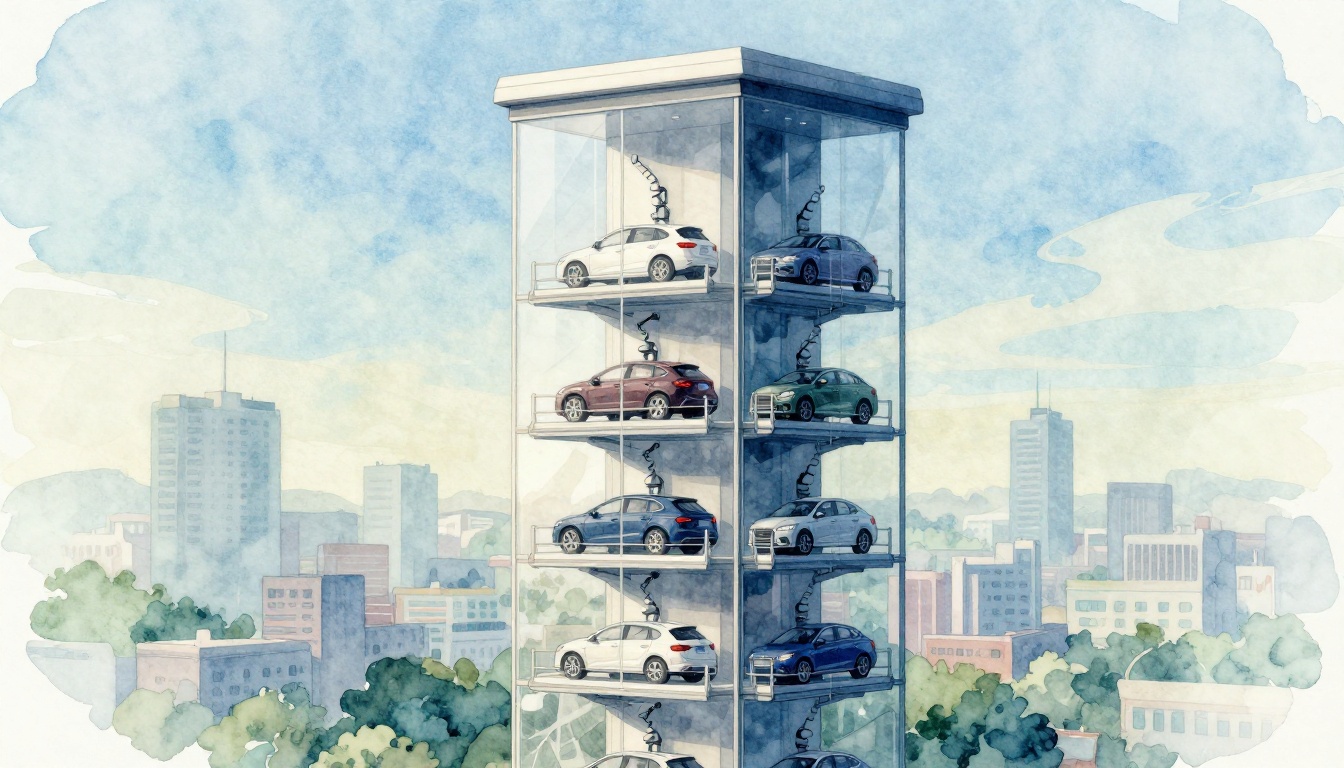
Ever sat in your car, circling downtown blocks, hoping a spot opens up before you lose patience? You’re not alone. Parking stress piles up fast, especially near busy offices, stadiums, and crowded events.
Automated parking systems aim to fix that problem. They use machines to park cars for you, often with lifts, robots, or shuttles. Instead of drivers squeezing into ramps and tight bays, you drive in, park, and the system handles the rest.
In this guide, you’ll get simple explanations for how automated parking works. You’ll also see the main system types, the real benefits (and the real limits), plus what’s happening in 2026.
What Exactly Is an Automated Parking System?
An automated parking system (often called an APS or “automated parking garage”) is a mechanical system that stores and retrieves cars in tight spaces. The key idea is simple: you don’t maneuver through ramps like a typical garage. You drive in, then the machines move your car to a storage position.
Think of it like a giant vending machine. You “drop in” your car, and the system delivers it later. Or picture a sliding puzzle, where platforms rearrange cars into the right spots. Either way, the goal stays the same, use space better than ramps and wide driving lanes.
In many designs, automated parking can store more cars in the same building footprint. Some projects aim for up to about 60% more space versus traditional garages, mainly because the design reduces wasted movement space.
What you’ll usually find inside
Most automated garages include a mix of hardware and software that work as one team:
- Lifts and platforms to move cars up, down, or sideways
- Sensors and cameras to confirm the car and track its position
- Motors or hydraulics to power movement and transfers
- Software (and sometimes an app) to manage assignments and retrieval
- Kiosks for entry, payment, and ticket handling
If you’ve ever wondered why these garages can feel “organized,” this is why. The system keeps strict control of where each car goes.
If you picture a basic layout, imagine an entry area connected to multiple storage bays stacked in rows or towers. The system’s “work” happens in the middle, where lifting and shifting equipment can swap cars into open spots.
For a practical walkthrough of different setups and layouts, see this automated parking system guide. It’s a helpful starting point before you go deeper.
The Basic Components That Make It All Happen
Automated parking systems work because several parts coordinate in real time. If one part fails, the whole process slows. But when they all work together, the experience can feel smooth and predictable.
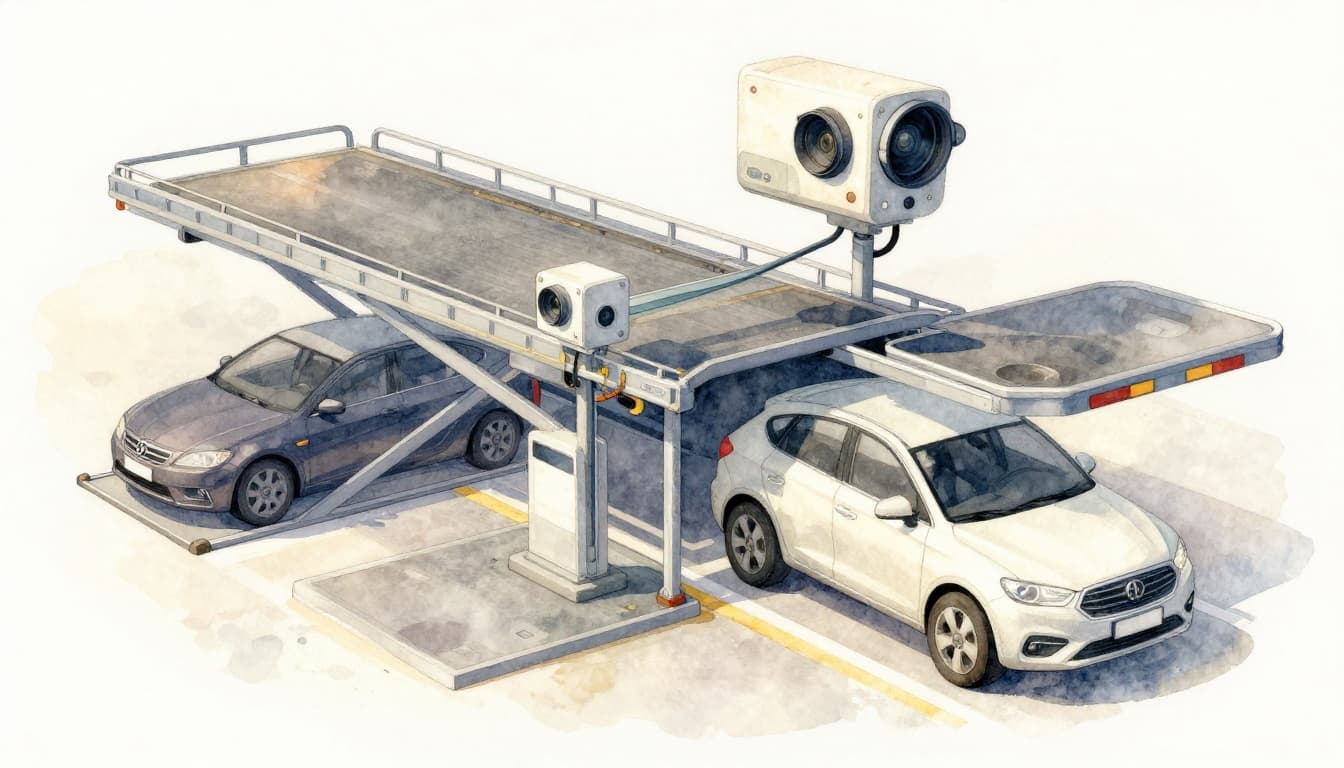
Here’s the simple breakdown.
Lifts and platforms move the car. They raise it, slide it, or rotate it into a storage position, depending on the system type.
Sensors act like “smart eyes.” They measure where the car is, confirm dimensions, and help the system avoid collisions.
Cameras for plate reading (LPR) help identify vehicles. That matters during entry and retrieval, especially when multiple cars are stored close together.
Motors and hydraulics provide power. These components move the hardware that actually shifts cars around.
Software and controls run the show. They track the car’s location, route it to the right slot, and guide the sequence for quick retrieval.
Kiosks and apps handle the human steps. You pay, confirm entry, and later scan or use your phone for retrieval.
In short, the system is less about fancy robotics you watch, and more about precise movement you don’t have to manage.
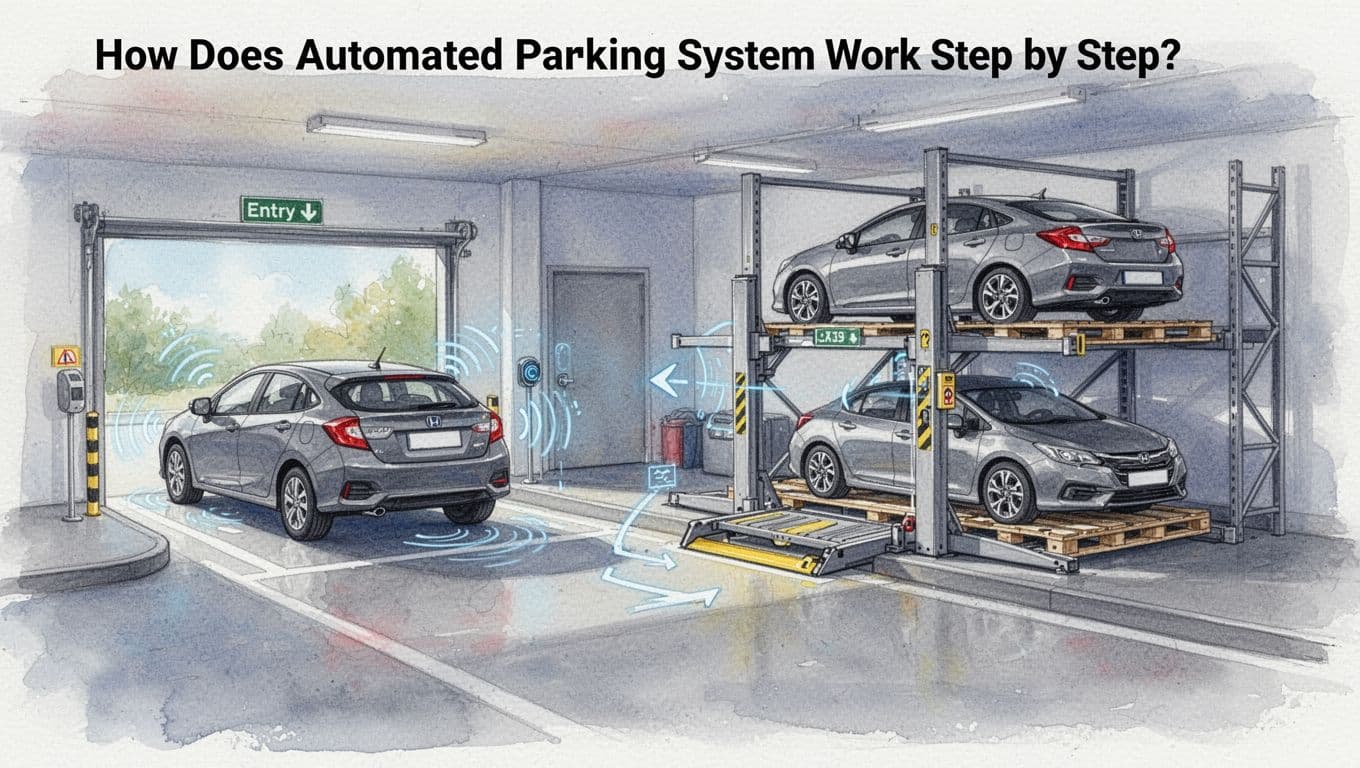
How Does an Automated Parking System Work Step by Step?
The best way to understand automated parking is to follow the flow from start to finish. While designs vary, most systems follow a similar pattern.
First, you drive in. Then you exit the car. After that, machines handle everything else.
Here’s a common step-by-step process:
- Drive into the entry bay and park in a marked spot. You usually keep the car straight for easy sensing.
- Exit the vehicle and confirm entry at a kiosk or with an app.
- Sensors and cameras scan the car (size, position, and often license plates).
- The system assigns a storage location based on availability and car type.
- Machines move your car to the assigned bay using lifts, shuttles, or robots.
- When you’re ready to leave, you scan your ticket or app code.
- The system retrieves your car and returns it to the entry point.
The big payoff comes from skipping the “circling problem.” Instead of hunting for a free ramp spot, you rely on the garage’s internal map and scheduling.
Some systems include touchless features, like app-based entry or license-plate reading. That can reduce delays at peak times. Also, retrieval times often stay predictable once the garage is running smoothly, even if rush hour adds pressure.
The retrieval experience matters most. You want cars to come back quickly, and you want fewer mistakes with which bay gets chosen.
Even so, no system is magic. If the garage is full, retrieval can take longer. That’s why the system’s scheduling software is so important.
The Most Common Types of Automated Parking Systems
Automated parking systems come in different “machine styles.” Some designs rearrange cars like sliding blocks. Others store cars vertically like stacked bins. The structure changes how fast cars can move and how many cars fit.
Below are the main types you’ll hear about, plus where each one tends to work best.
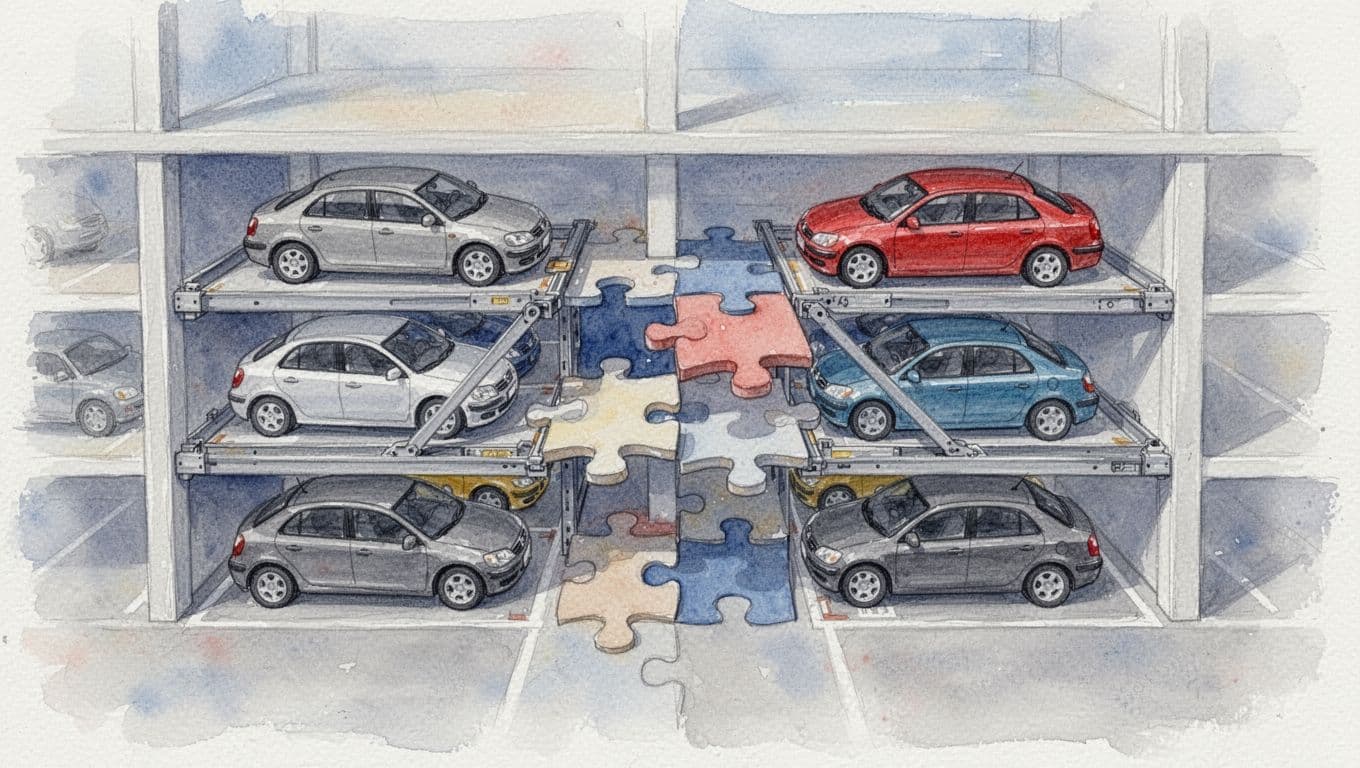
Puzzle Systems: Sliding Cars Like Puzzle Pieces
Puzzle systems use shifting platforms that slide cars into open spaces. Because the movement happens on a grid, the garage can pack cars tightly.
In plain terms, think of a board game. Platforms move in a sequence that creates room, then slides your car into the best spot. When retrieval happens, the system runs the sequence in reverse.
Puzzle systems often fit well for low- to mid-rise buildings. They also work nicely when developers want a compact footprint with clear storage zones.
Rotary Systems: Cars in a Moving Loop
Rotary, or paternoster-style, systems rotate storage bays in a loop. As the system turns, cars move from one position to the next, then arrive at an exit point when needed.
This style can work well when traffic is moderate and steady. Instead of shuttling each car through a complex path, the loop provides continuous movement. That can help with retrieval flow during normal busy periods.
Silo Systems: Vertical Storage Towers
Silo systems store cars in a vertical structure, often with one car per level. The machine moves the car up or down like an elevator, then delivers it to the entry point.
This approach can be a strong fit for tight urban lots. You build upward, and the tower holds many vehicles in a small ground area.
Also, vertical designs can be easier to understand for drivers. You drive in, the system lifts the car, and later it drops it back at the right bay.
Other automated designs you may see
Beyond the three types above, you might also run into:
Shuttle or conveyor systems: cars ride on carts or conveyors that move laterally and then vertically. These designs can handle moderate to high throughput.
Robotic-arm systems: machinery picks up a car and transfers it into storage. Some designs focus on flexibility for different parking sizes, but the overall performance depends on the facility layout.
If you’re comparing options as a developer or building owner, it helps to see real comparisons by system type. This article on selecting the right setup is a good reference: choosing puzzle vs robotic systems.
Top Benefits and Real Downsides of Automated Parking
Automated parking systems bring real value. They also come with tradeoffs. If you expect them to work like a regular garage with zero limits, you’ll be disappointed.
Why they help in busy cities
The biggest upside is space efficiency. Automated garages reduce the need for long ramps and wide lanes. As a result, they can fit more cars in a building footprint.
They also improve the driver experience. You don’t fight for turns or squeeze into tight driving paths. You park in the entry bay, then step out.
Safety matters, too. With fewer driver maneuvers inside the structure, there’s less risk of bumps from cramped traffic. Most systems also use cameras and controlled access, which adds security.
Here are the most common benefits:
- More cars per footprint (often cited around up to 60% in good designs)
- Faster entry and predictable retrieval when demand is balanced
- Lower internal traffic risk since cars move mechanically
- Better security with cameras, tracking, and controlled access
- Efficient operations for hotels, offices, and mixed-use sites
Also, the economics can be attractive for land-constrained areas. Building vertically often costs more, but ramps and larger garage footprints can cost more over time.
Challenges to watch out for
Now for the part people don’t always mention. Automated parking systems can cost more upfront. They also require specialized maintenance.
Here’s what to watch, especially in the US market:
- Higher initial cost: mechanical equipment and controls add up quickly
- Retrieval delays during peak spikes: if many people leave at once, queues form
- Power dependency: systems need backup plans for outages
- Car size limits: some systems fit certain vehicle lengths, widths, and heights only
- No quick “drop-off and leave” in many setups: the car still needs storage movement
A simple way to compare the reality is to look at “driver time” versus “garage time.” You spend less time searching and maneuvering. But the garage must schedule movement internally.
| What you gain | What you give up |
|---|---|
| Less circling and fewer in-garage turns | Waiting in a queue during busy exits |
| More cars in less space | Higher upfront build and equipment costs |
| More predictable access rules | Limits on vehicle size and clearance |
| Added tracking and security | Dependence on maintenance and power |
The right system can reduce the downsides. Still, the tradeoffs stay real.
Real-World Examples and What’s Happening in 2026
Automated parking isn’t just a future idea. It’s already in use in multiple countries, and the US is adding more systems in 2026, especially in dense districts.
A few big patterns stand out as of March 2026:
- More smart sensors and license plate reading (LPR) to reduce manual steps
- Mobile payments and Bluetooth-style entry to speed up arrival and exit
- AI and better scheduling to predict demand and reduce retrieval bottlenecks
- Higher adoption in high-rises where land is expensive and garage space is limited
In cities like Tokyo, automated parking has been common for years due to high demand and tight space. In parts of New York and Chicago, you’ll see more retrofits and new builds for offices and premium parking. Europe also has notable activity, including projects tied to industrial and vehicle-focused areas.
In the US, companies have offered systems for garages, hotels, and apartment buildings. Some projects also pair automated parking with EV planning, like reserved charging-ready spaces.
If you want more background on system categories and how facilities choose between them, this overview is useful: types of automated parking systems.
What future updates might change
As technology improves, the likely upgrades are practical ones:
- Quicker retrieval through better scheduling and smarter queue management
- Lower friction entry with mobile-first access and fewer kiosk steps
- More “touchless” flow by using LPR and validated entry rules
- Energy improvements using smarter controls and, in some cases, green power
A major long-term shift is integration with self-driving and advanced vehicle parking features. In that world, the “driver step” could shrink even more. Machines might coordinate with vehicle systems for smoother handoffs.
Conclusion
Automated parking systems solve a very human problem: the time you lose circling for a spot. They do it by using machines to store and retrieve cars without drivers navigating ramps and tight bays.
You now know the basics, what APS is, the main components, the typical entry and retrieval steps, and the most common system types like puzzle, rotary, and silo. You also saw the tradeoffs, mainly cost, queueing during peak exits, and vehicle size limits.
As this tech grows in the US, the systems in 2026 look more “hands-off” thanks to apps, LPR, and better scheduling.
Have you parked in an automated garage yet? Share your experience, then keep an eye out for how these systems handle busy event nights.