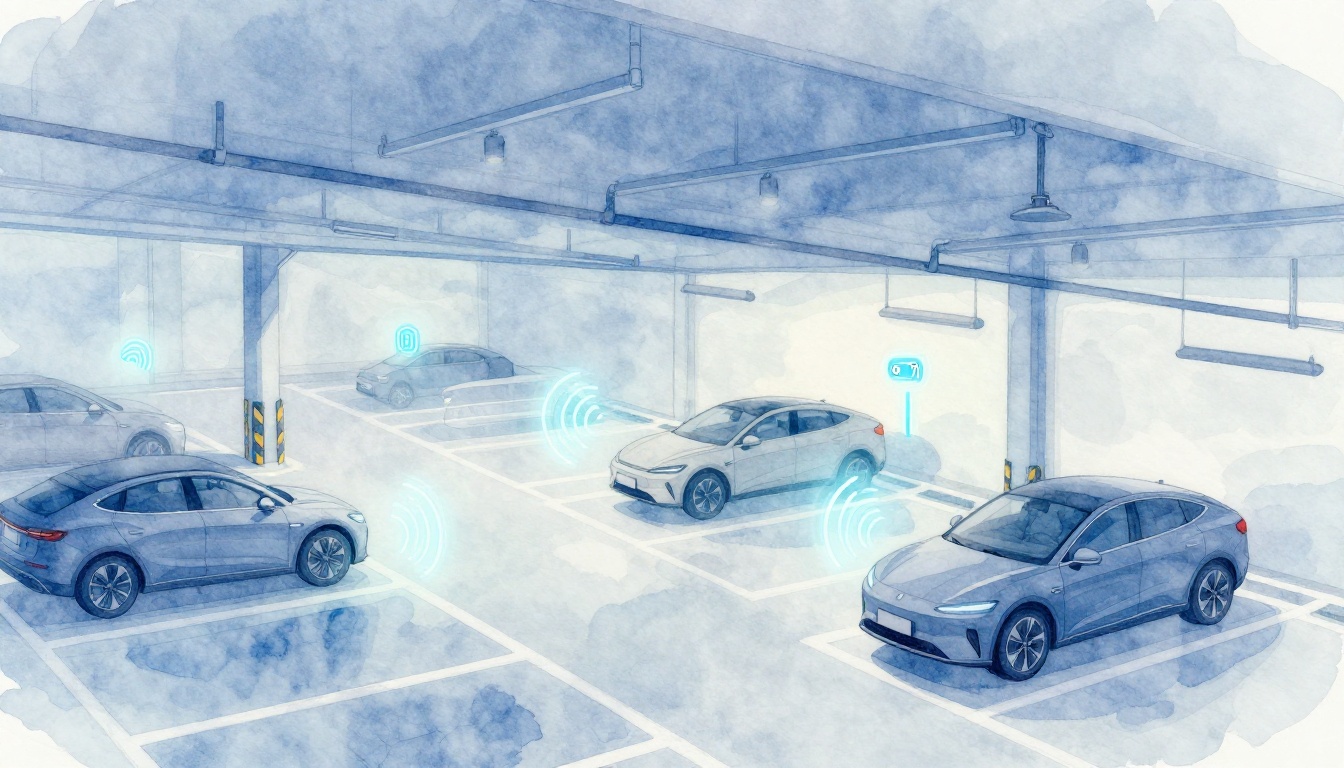
Have you ever circled the lot for 10 minutes, only to find every space is taken? Parking sensors exist to stop that headache fast. They check whether a spot is empty, then send that info to your car, a sign, or an app.
In 2026, parking sensors are no longer one-size-fits-all. You’ll see ultrasonic, magnetic, inductive loops, and AI camera systems, each with their own strengths. Industry reports also note that over 55% of new vehicles include parking sensors to reduce low-speed crashes, so the tech is getting more common every year.
Even better, smart guidance can cut the time you spend searching. Urban trials and industry trends point to 30% to 50% less circling time, which means less idling and less traffic pressure. That matters, because fewer loops around the block can translate to lower emissions in busy areas.
So how do these systems actually detect available spaces? Next, you’ll get a clear breakdown of the main sensor types, how each one “thinks” about emptiness, and where they can miss.
How Ultrasonic Sensors Spot Empty Parking Spots with Sound Waves
Ultrasonic parking sensors work a bit like a bat’s hearing. They send out high-frequency sound pulses, then listen for what comes back. You can’t hear these pings, but the sensor can measure the timing very precisely.
Here’s the basic flow for how they detect occupancy:
- The sensor emits an ultrasonic pulse.
- The pulse hits something, like a bumper or a parked car.
- The sensor listens for the echo to return.
- The system calculates the distance based on how long that echo took.
- Short or strong echoes usually mean the spot is occupied.
- No echo, or a longer echo delay, usually means the space is empty.
That “echo time” part is the key. In other words, the sensor isn’t guessing. It’s measuring distance. Most systems set thresholds, so they don’t trigger on small clutter all the time.
Where ultrasonic sensors get mounted
Ultrasonic sensors can appear in a few places, depending on the lot design:
- On the ground at each spot boundary
- On walls or posts aiming toward the target area
- Overhead for higher coverage (common in garages)
In tight indoor garages, this can be a practical setup. Outside, ultrasonic sensors often still do well, because the sound waves can handle many normal weather conditions.
A simple analogy for the idea
Picture shouting in a parking garage. If you hear your voice bounce back quickly, something is close. If it takes longer to return, there’s more open space. Ultrasonic sensors do that math at a much faster rate.
Real pros and cons of ultrasonic detection
Ultrasonic can be a strong choice when you need close-range sensing and predictable behavior. Still, it has tradeoffs.
Pros
- Works in many weather conditions
- Can be accurate for obstacles within a few meters
- Often cheaper than camera systems
Cons
- Typically needs a sensor per spot or tight grouping
- Can misread if something small sits in the detection zone
- If something blocks the field regularly (like thick snow buildup), accuracy drops
If you want a clear refresher on the basics of ultrasonic parking detection, see How Do Parking Sensors Work? – YouTube.
Real-World Setup and Reliability Factors
Installation details matter more than people think. With ultrasonic units, positioning drives performance.
In many lots, sensors sit slightly buried or mounted at a height that avoids damage from tire impacts. Others use surface mounting, especially when maintenance access matters. If the sensor aims too high or too low, the return echo can change even if the space stays the same.
Also, ultrasonic sensors deal with “real life,” not lab conditions:
- Rain can add noise, but the echo timing still often works.
- Snow and ice can cover parts of the sensor or scatter sound.
- Dust and leaves can create weak reflections.
- Tall objects nearby might fall into the detection field.
Apps and control boxes help here. When systems report occupancy to a central unit, the software can smooth out readings. That reduces flicker, like when a sensor briefly misreads a passing motorcycle.
Maintenance is usually simple. A quick cleaning and inspection can prevent buildup from affecting sound paths.
One more limitation to keep in mind: ultrasonic sensors focus on distance to objects. They don’t “know” if the object is a car, a trash bin, or a pole. That’s why good setup and clear sensing zones matter.
Magnetic Sensors: Catching Cars by Twisting Earth’s Magnetic Field
Magnetic sensors detect occupancy by listening for metal. Since most vehicles include ferrous parts, the sensor can spot a car based on how it changes the local magnetic field.
The core idea looks like this:
- An underlying magnetic sensor sits under or near the parking bay.
- The sensor reads the background magnetic field.
- When a car pulls into the space, its metal alters that magnetic field.
- The system detects the distortion and marks the spot as occupied.
This is an elegant approach because it doesn’t require sound, images, or a camera view. It also doesn’t care if the vehicle is in bright sun or dark at night.
A plain-language analogy
Think of the sensor like a hidden compass needle. When a car parks above it, the field shifts. The sensor measures that shift and sends the occupancy status.
How they communicate in real lots
Magnetic systems often use wireless networking so the installation stays manageable. In smart parking projects, wireless options can include long-range protocols such as LoRaWAN-style setups. That lets a central hub receive readings without trenching for every spot.
Pros and cons for real drivers
Pros
- Long life because they often rely on low-power electronics
- Hidden placement reduces vandalism risk
- Works 24/7, including in darkness
Cons
- Smaller vehicles or bikes may create weaker signals
- Ferrous content differences can affect detection strength
- If nearby metal structures exist, calibration may need attention
If you want a deeper explanation of how magnetic parking sensors detect cars, check What is a Magnetic Parking Sensor?.
Why They’re Perfect for Big Outdoor Lots
Magnetic sensors often fit large outdoor areas well. Since they’re usually tucked under the surface, they don’t create clutter in the visible space. That matters in lots where aesthetics and access both matter.
They also tend to keep working even when lighting changes. A lot can be bright at noon, then pitch black at midnight. Magnetic sensing doesn’t depend on a camera feed to interpret contrast.
In addition, many deployments pair these sensors with facility-grade controllers. Those systems report occupancy quickly and can scale to hundreds of spaces.
Some newer installations also aim to reduce ongoing maintenance. For example, when paired with solar power for the hub or networking nodes, the system can keep running with fewer trips by maintenance crews.
Inductive Loop Sensors: Wired Detection That’s Battle-Tested
Inductive loop sensors have a long history. They’re widely known in traffic detection, like counting cars at intersections. The same physics can help with parking space presence detection.
Here’s the idea in simple terms:
- A coil of wire gets embedded in the pavement.
- The system runs current through that loop.
- A vehicle’s metal changes the loop’s electromagnetic behavior.
- The controller reads that change as “presence” in the space.
The loop isn’t looking for the car’s shape. It’s looking for how the car affects an electrical field.
If you want a solid technical overview of the setup style used in real installations, see Inductive Loop Detector Basics.
Why this method can be very accurate
Inductive loops often perform well for vehicles because the metal presence creates a clear signal. Bicycles may still be harder, depending on the bike frame and nearby metals, but for cars the detection can be dependable.
The tradeoffs that come with cutting pavement
There’s a reason inductive loops aren’t always the first choice for retrofits. The install process can be more invasive:
- You usually cut into pavement to place the loop wire.
- You need cable routing and power for detection electronics.
- Once installed, you’ll want good workmanship to prevent faults.
That also means the project cost can be higher upfront, even if the sensor itself is straightforward.
In short, inductive loops tend to shine in planned builds, or when the site already supports similar wiring and infrastructure.
Where they fit best
Inductive loop detection often works well for:
- drive aisles and controlled entry points
- lots where vehicles stop in predictable positions
- areas where you want high reliability over fancy features
However, wireless sensor systems and camera setups can reduce installation work in new projects. That’s part of why you’ll see inductive loops less often in modern “spot-by-spot” parking guidance.
Camera Systems: AI and Vision Taking Over Parking Detection
Overhead camera systems detect occupancy using computer vision. Instead of measuring distance or metal, they analyze images.
Most modern setups do something like this:
- A camera captures an image (or short video frames).
- Edge AI models detect car shapes or motion and map them to parking slots.
- The system decides each slot as occupied or empty.
- It sends the result to a display, sign, or app.
Because one camera can cover multiple spaces, camera systems can scale well. One view might handle an entire row, or even more.
What “edge computing” adds here
A big shift in recent years is processing on the device. Edge AI means the camera hardware runs the analysis locally.
That reduces delay. It can also reduce the amount of data sent to the cloud. For many sites, this makes guidance feel more “instant.”
If you want an example of how edge vision is positioned for smart parking, see How AI and Edge Vision Sensors are Revolutionizing Smart Parking Systems.
Pros and cons that matter in real lots
Pros
- One camera can cover many spaces
- Better at handling mixed clutter than simple distance sensors
- Can support features beyond occupancy (like counting trends)
Cons
- Lighting and weather can affect image quality
- Privacy can become a major concern for some sites
- Installation must consider glare, shadows, and camera angles
Lighting changes are the biggest day-to-day challenge. A camera can struggle when:
- headlights blast into the lens
- sunlight glare hits the pavement
- snow or heavy rain reduces contrast
That said, AI models improve over time, and many systems use both setup tuning and smart filtering. Some solutions also merge camera logic with other sensors, like radar, to reduce mistakes.
Edge AI Makes It Fast and Private
Edge AI is often the difference between “looks good on a demo” and “works during rush hour.”
When the camera processes images locally, the system can:
- update slot status quickly
- avoid waiting for remote servers
- keep data handling tighter (since less raw video may leave the device)
For a driver, this shows up as less lag. For a site manager, it can mean lower bandwidth needs and simpler integration.
In practice, the guidance you see is the output of that local work. Green lights for open spaces, red for full ones, plus app updates in real time.
2026 Breakthroughs: Smarter Systems with IoT, LiDAR, and More
By 2026, “parking sensors” usually means more than one sensor type. It’s more like a small network of tools working together.
IoT connects everything so you get one clear answer
IoT (Internet of Things) ties sensor readings to a unified system. That means an app can show the same truth across the lot:
- where open spots are
- which entrances make sense
- how full each zone gets during the day
Instead of drivers hunting for signs, the system can route them. In busy areas, industry trends point to 30% to 50% less circling time, which improves flow.
Sensor fusion improves accuracy
Many new builds move beyond a single detection method. For example, camera systems can pair with radar. That helps when images are hard to interpret.
Radar can detect presence even in darker scenes or some adverse weather. Cameras can then confirm location relative to slot lines.
That combination reduces “false empty” and “false full” moments. It also helps systems handle unusual cases, like temporary barriers.
LiDAR and 3D mapping for better spatial awareness
LiDAR builds 3D maps from a point cloud. In smart parking, LiDAR can support advanced understanding of space layouts.
That becomes useful when lots need more than simple slot occupancy. For example, some systems can support guidance for self-parking cars or tighter maneuver zones.
Integration with EV chargers and traffic signals
In modern deployments, parking guidance can tie into:
- EV charger availability
- real-time traffic signal timing
- access control
So when a charger space frees up, drivers may get updated guidance immediately. If signals change, the route suggestion can shift too.
What it means for you as a driver
In the near term, you’ll likely see:
- fewer missed spots
- quicker guidance updates
- better performance across weather and lighting
In the long term, systems with stronger mapping and vehicle-to-infrastructure links can support fully automated parking guidance. Even partial self-parking features already rely on sensors like cameras, radar, and other detection methods.
The big win stays the same: fewer loops around a lot. Less time wasted. Less congestion.
| Sensor type | How it detects occupancy | Best fit | Typical weak point |
|---|---|---|---|
| Ultrasonic | Sound echo timing | Close-range spaces | Small clutter or blocked zones |
| Magnetic | Changes in magnetic field from metal | Hidden outdoor bays | Bikes or low-ferrous vehicles |
| Inductive loops | Metal alters an electromagnetic loop | Planned wired installs | Higher retrofit cost |
| AI cameras | Vision models identify cars by slot | Large lots, scalable views | Lighting and privacy concerns |
Conclusion: The common thread behind “empty” and “full”
Parking sensors detect available spaces by measuring the world in different ways. Ultrasonic units listen for echoes, magnetic sensors track metal effects, inductive loops read electromagnetic changes, and AI cameras spot cars through vision.
What makes 2026 systems feel better is coordination. IoT links sensors and apps, while edge AI keeps updates quick. As a result, you spend less time searching, and traffic flow improves.
If you want smoother parking, pay attention to the type of system a lot uses. Then you’ll know why it feels accurate in one place and not in another.
Next time you find a spot fast, take note. What sensor type do you think that parking system uses?