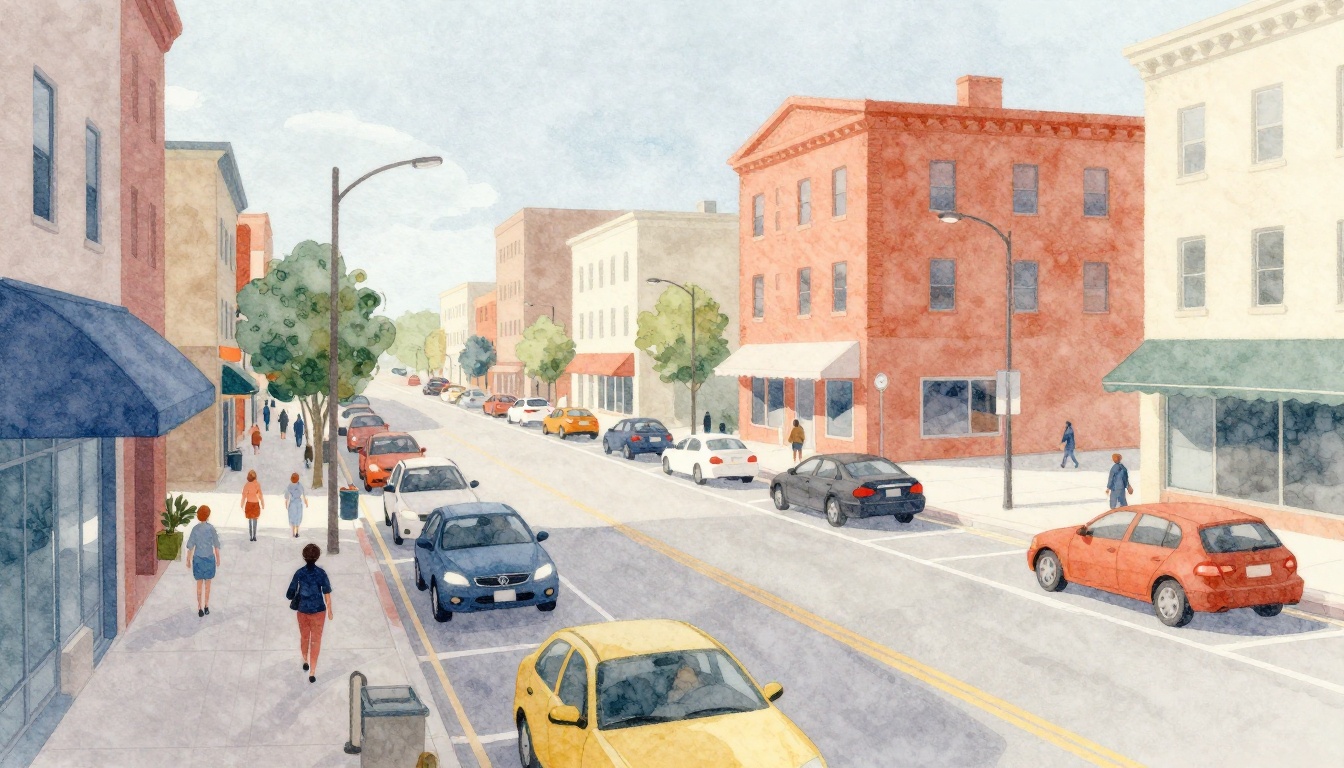
Have you ever circled one downtown block for 15 minutes during rush hour? You spot a turn signal, you think “this is my moment,” then the car pulls away. Cars keep flowing, and you’re stuck doing laps.
Here’s the frustrating paradox: busy areas often have lots of parking on paper. In real life, finding parking difficult in busy areas feels impossible near the exact block you need.
This happens because supply and demand don’t match when it matters most. Peak times pile up at the same entrances, so even a “full” city can still look empty where you’re standing.
Next comes the circling loop. When drivers hunt for a curb spot, they create more congestion and make the search worse for everyone.
Planning rules also play a role. Old parking mandates can force cities to build more car space than they can use well, pushing real destinations farther from your parking spot.
Understanding these factors helps drivers make smarter choices, and it helps cities fix the root causes instead of patching the symptoms.
How Peak Demand Overwhelms Limited Spots in Hotspots
Cities don’t run on averages. They run on moments, like 5:00 to 7:00 p.m. when offices empty and diners arrive. Even if a city has plenty of parking overall, hotspots near offices, theaters, and stadiums can hit near-full conditions fast.
Think of parking like a popular coffee shop during weekday mornings. The city might have many cafés, but you still feel stuck outside the one on your street. That’s what busy blocks feel like. Supply exists, but it’s not where your trip needs it.
Meanwhile, peak demand often concentrates on the same travel corridors. A few blocks can become the bottleneck for an entire neighborhood. Surface lots fill first, then curb parking gets “tight.” After that, drivers start moving, searching, and waiting.
A key twist is price. When parking is cheap or free, more drivers assume they can try their luck. That pushes more cars into the same curb zones. As a result, the shortage feels sharper, even if there are empty spaces elsewhere.
You can see the mismatch in local planning inventories too. For example, Philadelphia’s University City Parking Inventory looks at changing off-street supply and demand patterns around a busy growth area (including institutional and commercial parking). Reports like these show how supply shifts by block, and how “available parking” may not mean “walkable parking.” You can review that inventory here: Philadelphia’s University City parking inventory.
Here’s a simple way to picture what goes wrong:
| Time of day | Likely curb availability near destinations | What drivers experience |
|---|---|---|
| Off-peak (midday or late evening) | Many short vacancies | A quick pull-in feels normal |
| Peak (before events, work rush, weekend evenings) | Tight, blocks fill fast | Drivers circle, slow down, and miss openings |
The takeaway is simple. Peak demand creates local scarcity. Drivers then add their own traffic to the problem, and the loop feeds back into itself.
Real City Stats Revealing the Hidden Overbuild
One reason parking feels so broken is that cities can end up with the wrong kind of supply. Developers and planners may add spaces to meet rules, not because the spaces will be used where people want them.
In some areas, there’s also a “remote parking” problem. You might find a garage that’s half empty, but it’s two blocks away. When you’re on a tight schedule, two blocks becomes five minutes. Five minutes becomes anxiety.
Parking inventories often show this “overbuild” pattern, especially in dense metro regions where travel times are tight and land is expensive. If you want an example of how researchers map parking assets at a regional level, this dataset covers the San Francisco Bay Area parking space inventory: San Francisco Bay Area Parking Space Inventory. Regional inventories like this help explain why the city can look “parkable” while specific blocks still act like they’re out of space.
Costs also matter. Even when cities build parking, underground construction can be costly enough to reshape development decisions. As of early 2026 trends discussed by transportation research summaries, underground spots can cost far more than surface spots, which can raise project costs by large margins. When projects pass those costs along, parking often becomes a burden that cities manage through rules, not by matching real need.
So the next time you drive past an empty-looking garage and keep going, it’s not always your impatience. It’s a mismatch between what parking availability looks like on the map and what it feels like on the street.
Why Free Parking Fuels the Endless Hunt
When parking costs little or nothing, drivers treat curb spaces like “free chances.” That changes behavior. More people circle, more often, and they do it for longer.
It’s the classic “try again” effect. If it’s free, you can keep scanning the block without feeling the meter tick. If it costs money, you’re more likely to shift plans sooner, like parking in a garage or taking transit.
Then there’s the timing issue. Many drivers arrive within a narrow window, like right before a show or right as the commuter crowd pours out. At that moment, free curb parking turns into a shared resource under pressure.
Instead of a smooth flow of arrivals and departures, you get congestion. Drivers stop suddenly to look for a spot, then crawl forward again. Each small interruption slows everyone down.
This helps explain why “there’s parking somewhere” doesn’t help when you’re trying to reach a specific entrance. If the most convenient supply is the curb, and the curb is free, demand spikes there first.
A good rule of thumb: if parking is free and the area is busy, expect competition. It doesn’t mean parking is truly scarce. It means the “scarcity” is local, and the search time grows with every extra lap.
Why Circling Drivers Make Traffic Even Worse
Circling doesn’t just waste time. It adds cars to the road right when roads already feel crowded.
Here’s the loop. A driver arrives, can’t find a spot, turns the car around, then checks the next block. That movement adds extra trips that don’t support the original destination. So the street that should carry normal traffic starts carrying “parking search traffic.”
This is why busy corridors can clog even when lots and garages exist nearby. The problem is that cars are moving through the same limited streets again and again.
When drivers feel stuck, frustration rises fast. Some people get aggressive. Others miss buses and appointments. Businesses suffer when customers struggle to park close enough to enter quickly.
Traffic also hits public transit. Slower intersections and blocked lanes can slow buses and delay service. That makes transit less attractive, which pushes more drivers back into cars. In other words, circling can quietly steer people away from the solution.
A study-style summary of driver behavior in a T2 Systems report found that two-thirds of drivers waste up to 15 minutes searching for parking. You can read the coverage here: Two-Thirds of drivers waste time searching for parking.
That wasted time matters because it compounds. Multiply one driver’s 15 minutes by 50 or 100 drivers near the same blocks, and the street starts acting like a bottleneck.
Circling turns a short parking problem into a neighborhood traffic problem.
Some curb management issues also link to broader congestion patterns. For more on how curbside parking management affects traffic, see how poor curbside parking management causes urban congestion.
None of this means “drivers are the enemy.” It means the system rewards circling when it should reward turning off the hunt sooner.
The Time Sink of Endless Street Loops
Parking search time is easy to dismiss until it happens to you.
Imagine this scenario: you plan to meet someone, you drive in, and you lose 10 to 20 minutes just looking. You’re still near the block, but you’re late. Then you have to park farther away, because your patience ran out and your schedule now controls your choices.
That ripple affects more than your mood. It affects delivery timing, ride pickups, and service appointments. It can also increase the time drivers spend idling, which adds emissions in stop-and-go conditions.
The cost also shows up in simple household math. If parking search time steals 15 minutes twice a week, that’s more than an hour a month. People rarely track it, so it feels like “normal city life,” but it adds up.
Meanwhile, circling can push people toward last-minute decisions. They might pay for rideshare pickup instead of walking. They might cancel plans if the schedule breaks. Either way, the original trip goal becomes harder.
If you’ve ever yelled at a slowpoke while circling, you’re not alone. Busy curb zones tempt everyone into reactive driving. The traffic feels personal because your parking search feels urgent.
The street doesn’t get calmer while you keep hunting.
From Frustration to Fights and Alternatives
Circling also changes how people behave at the curb.
When people believe a spot is “right there,” they try to grab it. You see sudden lane changes, last-second stops, and sharp turns into driveways. Some drivers block other vehicles because they don’t want to lose the spot they think they found.
That behavior can escalate. It can also spill into nearby side streets where drivers cut through to escape the main choke point.
So what do people do when parking is rough? Many switch modes.
A lot of drivers start leaning on transit more often. Others use rideshare pickup zones where available. Some try walking from garages and lots farther away, even if it feels like a hassle at first.
Still, apps help only part of the issue. They can reduce uncertainty, but they can’t rewrite peak-time demand on their own. If the area is jammed, “finding” the nearest space doesn’t always mean “getting there fast.”
This is where cities need to act too. They can reduce circling by changing prices, improving curb rules, and guiding drivers to better choices earlier.
Drivers can help themselves as well. Even small habits can shift your odds.
Outdated Urban Rules Trapping Cities in Parking Hell
Some parking problems aren’t caused by drivers. They’re caused by rules that shape how development happens.
Many cities use minimum parking requirements. In simple terms, a rule may require a certain number of spaces per apartment unit or square foot of retail. That can sound sensible. Planners want to prevent residents and visitors from spilling onto the street.
However, minimum mandates often miss the real picture. In dense areas, people may use transit or walk more than planners assumed. They might share rides more often. They may park off-site and walk for short trips.
So the city ends up with extra supply in the wrong places and too little friction management near the destinations that matter.
Research syntheses and early outcomes in cities that repealed minimum parking requirements find consistent impacts on land use and mobility. For a broader overview, see the UCLA Institute of Transportation Studies work: minimum parking requirements research synthesis.
It’s also not just a mobility issue. Parking rules can make housing more expensive. As transportation reporting summaries note, required parking can add large costs to new projects, especially when underground garages are involved. Those costs then show up as higher rents or reduced development.
That can keep the city more car-dependent over time. It can also reduce walkable options, because land gets locked into parking lots and garages rather than homes, shops, and parks.
Minimum Parking Mandates That Backfire
Minimum parking mandates aim to reduce street crowding. But they often create a new set of problems.
First, they add cost to development. Developers build more spaces to meet code. That investment can raise prices for residents and businesses.
Next, those spaces can sit empty when demand doesn’t match the assumed use patterns. When parking costs or rules encourage driving but demand shifts, the city gets underused garages and stressed curbs.
Finally, minimum mandates can push cities to treat curb space as overflow storage. Instead of managing curb supply well, the city relies on “more built space” somewhere nearby.
That approach fails at peak times. A garage can look fine at 2:00 p.m. and still fail at 6:30 p.m., because the best spots are tied up at the wrong moments.
Land Waste Hurting Walkable Neighborhoods
Parking takes land. Even surface parking lots take up valuable space.
In dense cities, that land could support housing, retail, or transit access. Instead, it can become rows of spaces that don’t help your short trip when you need it.
Worse, oversized parking lots can create dead blocks. People don’t want to cross wide parking fields at night. Bikes and buses face conflicts with turning cars. Pedestrian routes get less direct.
So your “parking plan” ends up turning into a walking plan, then a safety concern, then a time problem again.
Density amplifies this. When lots of people live close together, the city needs the most practical use of land. Car storage competes with everything else.
That’s why so many reforms focus on changing how much parking is required at all, and how cities price curb access.
Crowded Cities and Rush Hours Pile on the Pressure
Busy areas aren’t only busy because of events. They’re busy because many people share the same space.
In high-density neighborhoods, curb space becomes like a small sidewalk at a festival. There isn’t enough room for everyone’s “right now.” Add rush hour, and the arrival windows narrow even more.
Then hybrid work changes patterns. Some commuters come in less often, but many still drive during peak windows when they do show up. That means peak parking pressure can remain stubborn, even if overall daily demand shifts.
The core issue stays the same: the curb is limited, and peak demand hits it quickly.
Cities can try to solve this with tech, like sensors and better signage. However, pricing and rules usually drive the biggest behavior changes. When curb parking is managed well, fewer drivers circle for a random chance.
Reform momentum is growing. For example, Kansas City news coverage in March 2026 reported possible changes to parking space requirements as the city looks to support downtown and Midtown growth. You can read the update through Kansas City may loosen parking requirements.
This kind of change aims to make room for more housing and better land use. It also pushes cities to treat parking as a managed asset, not an automatic promise.
Density’s Squeeze on Every Inch of Curb
Curb space is finite. One blocked lane can slow traffic for a whole block.
In dense areas, the “last 100 feet” matters. That’s where you park, then walk to your destination. If curb supply is tight, the street becomes a negotiation zone.
You feel it when you watch cars line up for curb spots. Even a small delay makes lines longer. Next, search time grows. Then traffic grows again.
That’s why parking feels worst near the most popular places: job centers, dining corridors, and event venues. Those blocks attract the highest concentration of arrivals.
If the city also lacks good wayfinding or curb rules, you add uncertainty. Uncertainty makes drivers drive slower and search longer.
Density doesn’t just mean more people. It means less room for error.
Shifted Patterns from Remote Work
Remote work didn’t erase parking issues. It changed them.
In some cities, commuter peaks spread out. In other places, peaks still spike on specific days, like meeting-heavy Tuesdays and Thursdays. That can create “mini rush hours” that feel just as brutal when everyone arrives at once.
Remote work can also increase the number of trips for errands clustered around appointments. People might drive in for one task, then another. That increases local turn-over demand near shopping, clinics, and schools.
So even if average occupancy improves, the busiest moments can remain crowded. Parking availability can look fine in a daytime snapshot and still feel impossible when you show up late.
The path forward is about matching supply and demand at the moment you need it. That means better curb management and smart planning, not just building more parking “somewhere.”
Conclusion: The Vicious Cycle Behind Busy-Area Parking Woes
Finding parking difficult in busy areas usually comes down to one thing: peak moments don’t match local supply. When curb access tightens, drivers circle, streets slow down, and the problem spreads.
Outdated planning rules can make it worse too. Minimum parking requirements can raise project costs and push land toward underused car storage. Density then turns those choices into daily stress.
If you’re stuck searching next time, start with small tactics. Arrive earlier when you can, use a parking app to compare walking time, and consider transit when the destination is one or two stops away.
For cities, the best fix is a mix: manage the curb, price it more realistically, and update parking mandates that no longer fit how people travel.
What’s your worst parking story from a busy area, the moment that made you swear you’d never circle again?